






Force Motors Produces 2,00,000th Mercedes-Benz Engine in India
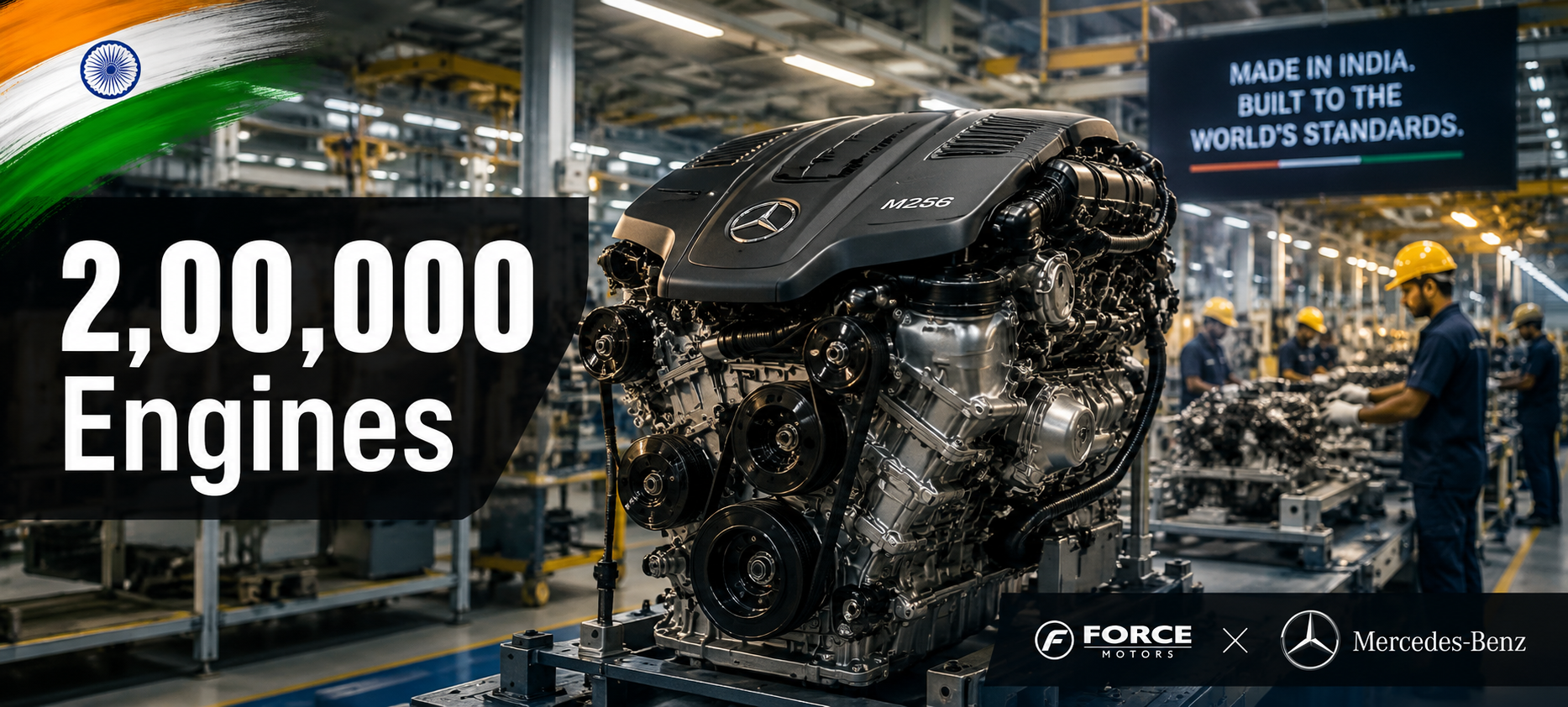
Quick Answer: Force Motors has produced its 2,00,000th Mercedes-Benz engine in India, marking a historic milestone in the two companies' partnership that began in 1997. The milestone engine is a 6-cylinder M256 petrol unit installed in the Mercedes-Benz GLS 450, and it was manufactured at Force Motors' Chakan plant in Pune.
A Landmark Moment in Indian Automotive History
Numbers tell stories, and in the automotive world, some numbers carry more weight than others. The 2,00,000th Mercedes-Benz engine rolling off the production line at Force Motors' Chakan plant in Pune is one of those moments. It is not just a production statistic, it represents nearly three decades of precision engineering, trust between two very different organisations, and a quiet but significant shift in where global automotive manufacturing is headed.
Force Motors, a Pune-based Indian automotive manufacturer, has been building engines for one of the world's most demanding automobile brands since 1997. The milestone 2,00,000th unit is a 6-cylinder M256 petrol engine, the same engine that powers the Mercedes-Benz GLS 450, a premium luxury SUV sold in global markets. That this engine is made in India, at an Indian facility, to the exacting standards Mercedes-Benz requires worldwide, speaks volumes about how far India's manufacturing capability has come.
What Milestone Has Force Motors Achieved?
Force Motors has crossed the landmark of manufacturing 2,00,000 engines for Mercedes-Benz at its Chakan facility in Pune. The milestone engine, the 2,00,000th unit, is a 6-cylinder M256 petrol engine, which has been installed in the Mercedes-Benz GLS 450. This achievement comes as the partnership between Force Motors and Mercedes-Benz approaches its third decade, making it one of the most enduring and successful manufacturing collaborations in India's automotive sector.
| Milestone | Details | Significance |
|---|---|---|
| Milestone Engine | 2,00,000th Mercedes-Benz engine produced in India | Marks a historic production landmark in the partnership |
| Engine Type | 6-cylinder M256 petrol engine | High-performance, globally used premium engine platform |
| Installed In | Mercedes-Benz GLS 450 | A flagship luxury SUV in Mercedes-Benz's global lineup |
| Manufacturing Location | Chakan Plant, Pune, Maharashtra | One of India's premier automotive manufacturing hubs |
| Partnership Start | 1997 | Approaching three decades of uninterrupted collaboration |
Why Is the 2,00,000th Mercedes-Benz Engine Production Significant?
On the surface, reaching 2,00,000 units sounds like an internal production target. But the significance goes well beyond the number itself. Consider what it actually takes to manufacture a Mercedes-Benz engine: sub-millimetre tolerances, rigorous quality inspections at every stage, global supply chain compliance, and zero room for inconsistency. Achieving this at scale, in India, over decades, is no small feat.
This milestone carries weight for several reasons:
- It validates India's precision manufacturing capability at the highest end of the automotive spectrum.
- It demonstrates long-term confidence from a globally recognised German automotive giant in an Indian manufacturing partner.
- It contributes to the localization ecosystem components, materials, and skills that feed into the production process are increasingly India-based.
- It reinforces Pune's position as one of Asia's most capable automotive manufacturing centres.
- It sets a benchmark for other global automotive brands considering India as a manufacturing base.
How Has the Force Motors and Mercedes-Benz Partnership Evolved Since 1997?
When Force Motors and Mercedes-Benz entered into their manufacturing agreement in 1997, India's automotive industry was in a very different place. The liberalisation of the economy was still finding its footing, and the idea of an Indian company building engines for a German luxury brand at global quality standards was ambitious to say the least.
What has unfolded over the following 27-plus years is a story of consistent delivery, continuous quality improvement, and expanding scope. The partnership began with a focused mandate and has grown to cover not just engine manufacturing but also the supply of axles and other critical components to Mercedes-Benz's operations in India.
| Period | Key Development |
|---|---|
| 1997 | Partnership between Force Motors and Mercedes-Benz established |
| Early 2000s | Production scale-up at the Chakan facility; quality systems aligned with global Mercedes-Benz standards |
| Mid 2000s–2010s | Expansion of scope to include axles and critical sub-assemblies alongside engine manufacturing |
| 2010s–Present | Continued production of advanced engine platforms including the M256 series |
| 2024–2025 | Production of the 2,00,000th Mercedes-Benz engine, a landmark moment for both companies |
The partnership's longevity itself tells a story. In the automotive world, supplier relationships are frequently reviewed and reassigned. The fact that Mercedes-Benz has continued to deepen its manufacturing tie-up with Force Motors over nearly three decades reflects genuine confidence in the quality, consistency, and reliability of what comes out of the Chakan plant.
The M256 6-Cylinder Petrol Engine: What Makes It Special?
The M256 engine is part of Mercedes-Benz's modular engine family, and it represents the brand's approach to balancing performance with efficiency in the premium segment. As a 6-cylinder inline petrol unit, the M256 is characterised by:
- Advanced engineering architecture designed for high performance and fuel efficiency
- Integration with Mercedes-Benz's EQ Boost mild hybrid system in select applications
- Deployment across multiple premium and luxury vehicle lines globally
- Manufacturing to tight dimensional and performance tolerances
- Compliance with stringent global emissions and quality standards
The GLS 450, which houses the milestone 2,00,000th engine, is one of Mercedes-Benz's largest and most premium SUVs. It is sold across major global markets, which means an engine built in Pune, India, is quite literally going into vehicles driven by customers in Germany, the United States, China, and the Middle East. That is the scale of what Force Motors' manufacturing capability represents.
What Role Does the Chakan Plant Play in India's Automotive Manufacturing Sector?
Pune's Chakan corridor is one of India's most important automotive manufacturing zones. It hosts facilities from a range of domestic and international automotive players, and Force Motors' plant is among its most technically distinguished operations.
The Chakan facility's ability to manufacture Mercedes-Benz engines sets it apart from a standard auto components plant. It operates under quality management systems aligned with global OEM requirements, employs a technically trained workforce, and maintains supply chain integrations that span both domestic and international sources.
For India's automotive ecosystem, a plant like this serves multiple purposes:
- It creates skilled employment in engineering, manufacturing, and quality assurance
- It develops a local supplier ecosystem capable of meeting international standards
- It attracts further investment from global automotive brands evaluating India as a production base
- It contributes to India's industrial export capability
- It builds institutional knowledge that strengthens India's automotive R&D potential over the long term
Key Achievements of the Force Motors–Mercedes-Benz Partnership
| Achievement | Details |
|---|---|
| Total engines produced | 2,00,000 Mercedes-Benz engines manufactured in India |
| Milestone engine model | M256 6-cylinder petrol engine |
| Vehicle application | Mercedes-Benz GLS 450 — a global luxury SUV |
| Component scope | Engines, axles, and other critical automotive components |
| Quality standard | Aligned with Mercedes-Benz's global manufacturing benchmarks |
| Duration of partnership | Nearly three decades (since 1997) |
| Manufacturing base | Chakan Plant, Pune, Maharashtra, India |
Impact on India's Automotive Manufacturing Sector
India's automotive sector is in the middle of a significant transition. The country has long been a major market for vehicle sales, but it is increasingly positioning itself as a global manufacturing hub for both finished vehicles and the components that go into them.
The Force Motors–Mercedes-Benz partnership is one of the cleaner examples of what this transition looks like in practice. An Indian company, working with a globally dominant European OEM, manufacturing high-complexity engine units to world-class quality standards, at a facility in India. This is precisely the kind of industrial outcome that the Government of India's Make in India initiative has sought to encourage.
For the broader Indian auto component industry, this milestone matters for a few reasons. First, it raises the credibility benchmark demonstrating that Indian manufacturers can sustain quality at this level and at this volume. Second, it creates a reference point for negotiations between global OEMs and Indian suppliers, showing that deep, long-term manufacturing partnerships are viable in India. Third, it strengthens the case for further investment into India's automotive manufacturing infrastructure, both by domestic players and international brands.
Localization and the India Manufacturing Story
One of the most important aspects of the Force Motors–Mercedes-Benz arrangement is what it means for localization. The automotive industry globally is grappling with supply chain vulnerabilities, and one of the responses to this has been a push toward manufacturing closer to key markets.
India, with its large domestic market, competitive manufacturing costs, improving infrastructure, and growing technical workforce, is well-positioned to benefit from this trend. The partnership between Force Motors and Mercedes-Benz, which has been running for nearly three decades shows that localising premium automotive manufacturing in India is not just theoretically feasible but practically proven.
The supply of axles and other components alongside engines further deepens this localization story. It means that a meaningful proportion of the components going into Mercedes-Benz vehicles assembled in India are being sourced from Indian manufacturing operations, reducing dependence on imported parts and building resilience into the supply chain.
Related Industry Resources
Explore more on these topics for deeper context on India's industrial growth:
- Automotive Manufacturing in India
- Make in India Success Stories
- Mercedes-Benz India Manufacturing Operations
- Pune Industrial Hub
- Indian Auto Component Industry
- Future of Automotive Engineering
Expert Perspective: What Industry Observers Are Saying
Automotive industry analysts who track India's manufacturing sector have consistently pointed to long-term OEM-supplier partnerships as a key driver of quality improvement and technology transfer in the country. The Force Motors and Mercedes-Benz collaboration is often cited as an example of how sustained engagement rather than transactional, project-by-project contracts leads to meaningful industrial outcomes.
The decision by Mercedes-Benz to manufacture engines like the M256 in India rather than importing them entirely reflects a broader strategic calculation. India offers manufacturing cost advantages alongside an increasingly sophisticated industrial base. For global luxury automotive brands, sourcing engines from a trusted Indian partner like Force Motors allows them to remain cost-competitive in the Indian market while maintaining the quality levels their brand demands globally.
From a supply chain resilience perspective, having engine manufacturing capacity within India also reduces exposure to international logistics disruptions a consideration that has become increasingly important for global OEMs following the supply chain shocks of recent years.
Looking Ahead: What the Future Could Hold
The automotive industry is going through one of its most significant transformations in history, driven by the shift toward electric vehicles, advanced driver assistance systems, and connected mobility platforms. Within this context, the Force Motors–Mercedes-Benz partnership is likely to face both opportunities and new questions.
On the opportunity side, India's manufacturing capabilities continue to grow. Government policy under initiatives like Make in India and the Production Linked Incentive (PLI) scheme for automotive components is actively encouraging deeper localisation and higher-value manufacturing. For Force Motors, the credibility built through 2,00,000 engines for Mercedes-Benz is an asset that positions it well for future conversations about expanded scope or new component categories.
At the same time, the broader shift toward electrification in the premium automotive segment raises questions about the long-term trajectory of internal combustion engine production. How both companies navigate this transition and whether the partnership evolves to encompass electric drivetrain components or other high-value parts will be something the industry will watch with interest.
Conclusion: A Milestone That Reflects More Than Numbers
The production of the 2,00,000th Mercedes-Benz engine by Force Motors at the Chakan plant in Pune is more than a production record. It is a statement about Indian manufacturing's ability to compete and deliver at the highest global standards over the long term.
For Force Motors, it is the result of nearly three decades of consistent quality and the confidence of a globally respected partner. For Mercedes-Benz India, it is evidence that a robust, reliable manufacturing ecosystem exists within the country to support premium vehicle production. For India's automotive industry as a whole, it is a milestone that adds credibility to the country's ambitions as a global manufacturing hub.
And for anyone watching India's industrial story unfold, the 2,00,000th engine is a quiet but powerful reminder that the country's best manufacturing story is still being written.
FAQ
Q1: What milestone has Force Motors achieved in engine manufacturing?
A1: Force Motors has produced its 2,00,000th Mercedes-Benz engine in India. The milestone engine is a 6-cylinder M256 petrol unit, manufactured at the company's Chakan plant in Pune and installed in the Mercedes-Benz GLS 450.
Q2: When did Force Motors and Mercedes-Benz begin their partnership?
A2: The partnership between Force Motors and Mercedes-Benz began in 1997, making it a collaboration approaching three decades. Over this period, the two companies have built one of India's most significant examples of global-standard automotive manufacturing.
Q3: What is the M256 engine and why is it significant?
A3: The M256 is a 6-cylinder petrol engine developed by Mercedes-Benz. It is a high-performance, technologically advanced unit used in premium vehicles like the GLS 450. The fact that it is manufactured in India at global quality standards reflects the maturity of India's automotive engineering capabilities.
Q4: Where are Mercedes-Benz engines manufactured by Force Motors?
A4: Force Motors manufactures Mercedes-Benz engines at its Chakan facility near Pune, Maharashtra. The Chakan plant is equipped to meet the stringent quality and precision requirements that Mercedes-Benz demands for its global-standard engine production.
Q5: What other components does Force Motors supply to Mercedes-Benz?
A5: Beyond engines, Force Motors also supplies axles and other critical automotive components to Mercedes-Benz. This broader supply relationship underscores Force Motors' role as a comprehensive manufacturing partner, not just an engine producer.
Q6: How does this milestone reflect India's role in global automotive manufacturing?
A6: Producing 2,00,000 Mercedes-Benz engines in India demonstrates that the country's automotive industry has the engineering capability, quality infrastructure, and skilled workforce to manufacture premium European vehicle components at a global level.
Q7: What is the significance of the Chakan plant in Pune?
A7: The Chakan plant is one of India's key automotive manufacturing hubs. Its ability to produce engines for a brand like Mercedes-Benz at international quality benchmarks positions Pune as a credible location for high-precision automotive manufacturing.
Q8: How does this achievement connect with the Make in India initiative?
A8: This milestone is a strong example of the Make in India initiative at work. A globally recognised automotive brand like Mercedes-Benz is manufacturing premium components on Indian soil, supporting local employment, industrial capacity, and the country's export potential.
Q9: Will Force Motors and Mercedes-Benz continue to expand their collaboration?
A9: While no specific expansion plans have been publicly announced at this stage, the track record of nearly three decades of quality production and this significant volume milestone positions both companies well for a continued and potentially expanded partnership.
Q10: What does this mean for the Indian auto component industry?
A10: This achievement raises the global profile of India's auto component sector. It demonstrates that Indian manufacturers can meet the exacting standards required by the world's top automotive brands, encouraging further investment and technology transfer into the domestic industry.