







Fuel Quality in India: How to Know You’re Getting the Right Grade
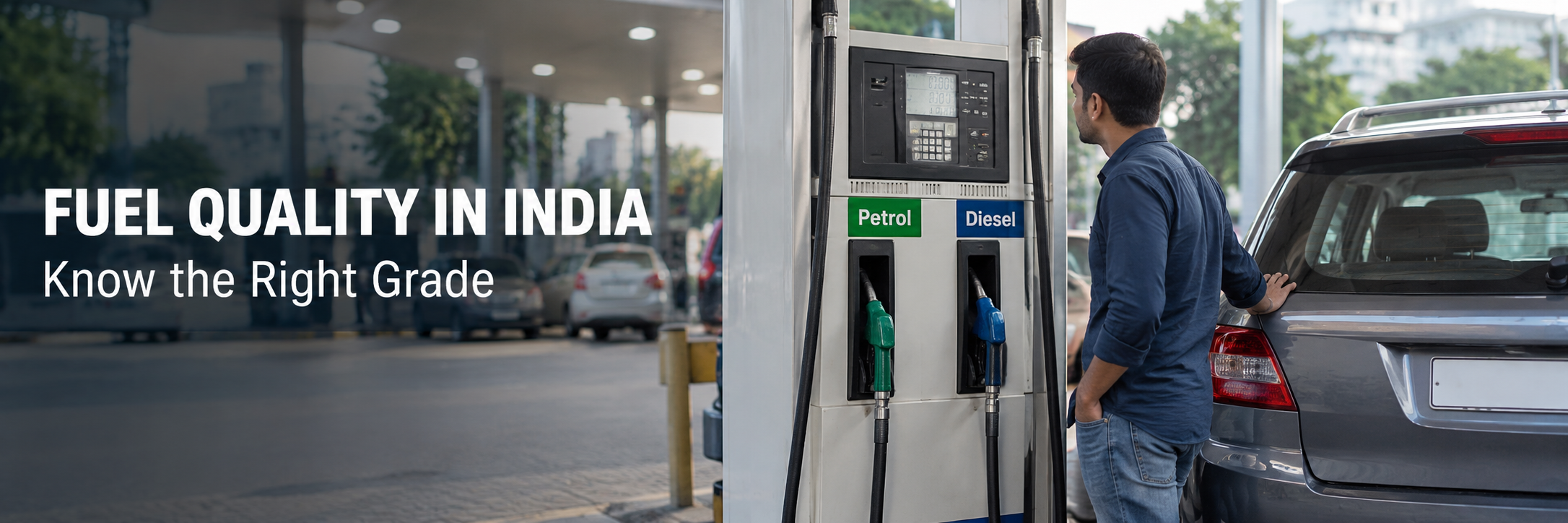
Quick Answer: Check your vehicle owner's manual for the recommended petrol or diesel specification, then match it to the octane rating or fuel type shown at the pump. Buy from reliable outlets and keep receipts. Higher octane is not automatically better for every engine. Fuel quality concerns need formal testing, because appearance and smell cannot confirm compliance.
Most Indian motorists tell the attendant "petrol" or "diesel", pay and drive off. For many vehicles that is enough. For modern turbocharged engines, older vehicles and high-mileage commercial fleets, the details matter more.
This guide explains how fuel grades work in India, how to match fuel to your vehicle, what you can and cannot check at a pump, and where to complain if something goes wrong. It does not rank brands.
What Does Fuel Quality Mean in India?
Fuel quality means petrol or diesel meets its specification for properties such as octane or cetane, sulphur, density and cleanliness.
The Bureau of Indian Standards (BIS) publishes these specifications. IS 2796 covers motor gasoline and IS 1460 covers automotive diesel. Oil marketing companies such as Indian Oil Corporation Limited, Bharat Petroleum Corporation Limited and Hindustan Petroleum Corporation Limited publish product data sheets showing the parameters their fuels are tested against.
Quality can change after the refinery. Water ingress or contamination can occur during transport, storage or dispensing, so handling across the supply chain matters as much as refining.
What Is the Difference Between Fuel Quality and Fuel Grade?
Fuel quality is whether fuel meets its specification. Fuel grade is the category it is sold in, such as petrol with a minimum octane rating.
A fuel can be the right grade and still be contaminated. A clean, compliant fuel can also be wrong for a particular engine. Four terms are worth separating:
- Fuel quality: whether the product meets its specification.
- Fuel grade: the labelled category, such as RON 91 or RON 95 petrol.
- Fuel quantity: how many litres the dispenser actually delivers.
- Fuel suitability: whether the fuel matches what your engine's manufacturer requires.
Each one is checked differently, and none proves the others.
What Are the Main Petrol Grades Available in India?
BIS lists BS VI petrol at a minimum Research Octane Number (RON) of 91 for regular grade and 95 for premium grade. Marketed premium products can go higher.
An amendment to IS 2796 in March 2024 added RON 95 grades, including a 10 percent ethanol blend. The Ministry of Petroleum and Natural Gas has also directed oil companies to sell petrol with up to 20 percent ethanol (E20) at a minimum RON of 95 from 1 April 2026, with provision for limited regional exemptions. Check the dispenser label and the company's product page for what your outlet sells.
Regular petrol
The default grade at most outlets, suitable for most vehicles that support the ethanol blend on sale.
Premium petrol
Sold under company brand names, usually with a higher octane rating and sometimes extra additives. Formulations differ by company.
High-octane petrol
Some companies market petrol with octane ratings well above 95, aimed at performance cars and motorcycles. Read the stated rating on the company's product page.
Octane rating and vehicle compatibility
Octane measures resistance to knock, which is uncontrolled combustion in the cylinder. High-compression and turbocharged engines are designed for higher octane. An engine designed for RON 91 or 95 does not necessarily gain from more.
What Types of Diesel Fuel Are Available in India?
Most diesel vehicles run on standard BS VI automotive diesel meeting IS 1460, with a minimum cetane number of 51 and maximum sulphur of 10 ppm, as listed in company data sheets. Some companies also sell premium diesel.
Standard automotive diesel
Available at almost every outlet. The specification permits up to 7 percent FAME biodiesel.
Premium or branded diesel
Marketed with a higher cetane number and additives. IndianOil, for example, states a cetane number of 55 for its premium diesel against 51 for normal diesel. Benefits depend on the engine and how it is used.
Diesel quality and vehicle compatibility
Modern common-rail engines have precise injectors and are sensitive to water and dirt. Use only automotive diesel. Never mix in petrol or kerosene, and avoid unapproved additives.
Cetane number and its significance
Cetane number measures how readily diesel ignites under compression. Octane measures knock resistance in petrol. They are different scales and cannot be converted or compared.
What Is the Difference Between Regular Petrol and Premium Petrol?
Premium petrol usually has a higher octane rating and may include product-specific additives. Whether it helps depends on your engine and the product.
Premium fuels differ by company, so do not assume identical formulations. A benefit is most likely in engines designed for high octane. In an engine designed for regular petrol, a gain in mileage or power is not guaranteed.
Does a Higher Octane Rating Mean Better Fuel?
No, not automatically. Octane measures knock resistance, not cleanliness, energy content or overall quality.
A lower-octane fuel can be clean and fully compliant. A high-octane fuel can still be contaminated. Using less octane than your manual requires can cause knocking, though many modern engines adjust ignition timing, which may reduce performance. Using more than required may bring no noticeable benefit.
How Can You Check Whether You Are Getting the Right Fuel Grade?
Read the owner's manual, confirm the product on the dispenser before fuelling, and keep the receipt. These steps check selection and suitability, not purity.
- Check the owner's manual: find the recommended fuel type, minimum octane rating and ethanol compatibility.
- Check the fuel flap: many manufacturers print the fuel type inside the flap or on the cap.
- Confirm the fuel type before dispensing: say petrol or diesel clearly. If the wrong fuel goes in, do not start the engine and call for assistance.
- Understand the advertised octane rating: figures such as 91 or 95 refer to RON, and product names vary by company.
- Review the station's displayed information: read product names, price boards and complaint contact details.
- Ask the attendant to confirm the product: a quick check prevents most selection errors.
- Retain the receipt: it records date, product and volume if you need to raise a complaint.
How Can You Check Fuel Quality at a Petrol Pump?
Choose a reputable outlet, watch the dispenser start from zero, and use the checks the outlet is expected to offer. Only laboratory testing against the BIS specification can establish compliance.
Outlets in the networks of oil marketing companies work under Marketing Discipline Guidelines, which the companies issued on the Ministry's direction and which cover inspections and malpractice checks. Authorised outlets are a sensible starting point, though a brand name is not proof of any single litre's quality.
Understanding quantity verification
Quantity checks confirm litres delivered, not quality. Make sure the display resets to zero. Outlets are expected to keep a calibrated 5-litre measure, and state Legal Metrology departments verify dispensers. If an outlet refuses a check, report it to Legal Metrology.
Understanding the limits of visual checks
Outlets may offer simple checks such as a density reading or filter paper test. These can reveal obvious problems like visible dirt or water, but they cannot confirm compliance. Colour, smell and touch are not reliable tests, and fuel is flammable and hazardous. Never take samples into containers or test fuel at home.
When laboratory testing is needed
A formal result needs sampling and testing at an approved laboratory, arranged through the oil company or the relevant authority. No complaint guarantees a test. Complaint steps are covered in the section on suspected adulteration below.
What Are the Signs of Poor-Quality, Contaminated, or Incorrect Fuel?
Hard starting, misfiring, hesitation, loss of power, rough idling or a warning light soon after refuelling can all point to a fuel problem. They do not prove one.
- Unusual engine behaviour after refuelling
- Difficulty starting
- Misfiring or loss of power
- Unexpected engine warning lights
- Possible contamination or water ingress
Worn spark plugs, weak batteries, faulty sensors, clogged filters and injector issues cause the same symptoms. If problems begin immediately after refuelling, stop safely and call roadside assistance or an authorised service centre.
What Should You Do If You Suspect Fuel Adulteration?
Stop driving if the engine runs badly, keep the receipt, record the station details and report through the oil company's grievance process. Suspicion is not confirmed adulteration.
- Stop safely: do not keep driving or refuel. Call roadside assistance.
- Record details: station name, location, date, time, pump number, product and the receipt.
- Raise it at the outlet: ask for the complaint book and make a written entry.
- Use the company grievance process: use the contact details displayed at the outlet or on the oil company's official website.
- Report quantity concerns: contact the state Legal Metrology department.
- Use consumer channels: the National Consumer Helpline (1915) and the district consumer commission under the Consumer Protection Act 2019. Verify current channels on official sites.
A complaint does not guarantee a laboratory test, compensation or a particular legal result. A written workshop diagnosis helps separate fuel causes from mechanical ones.
What Fuel Standards and Regulations Apply in India?
BIS sets fuel specifications under IS 2796 for petrol and IS 1460 for diesel. Bharat Stage VI sets vehicle emission limits. The Ministry of Petroleum and Natural Gas directs fuel policy.
These address different things. BIS specifications define what the fuel must contain and how it must perform. Bharat Stage VI emission standards define what comes out of a vehicle's exhaust. BS VI vehicles are designed around fuel with sulphur capped at 10 ppm, and BS VI fuel has applied nationwide since April 2020.
- Oil marketing companies: supply fuel, publish product data and enforce Marketing Discipline Guidelines at their outlets.
- Petroleum Planning and Analysis Cell (PPAC): publishes petroleum statistics and analysis. It does not inspect pumps.
- Petroleum and Explosives Safety Organisation (PESO): covers safety in storage and handling, not fuel quality.
- ARAI and SIAM: the Automotive Research Association of India tests and certifies vehicles, and the Society of Indian Automobile Manufacturers represents manufacturers.
- Central Pollution Control Board: works on environmental and emission-related norms.
No single body inspects every pump or handles every complaint.
How Does Fuel Quality Affect Mileage, Performance, and Engine Life?
Right-grade, compliant fuel supports the engine as designed. Poor or unsuitable fuel can hurt performance and increase deposits. Gains from upgrading are vehicle specific.
Mileage also depends on driving style, load, tyres, traffic and maintenance. Ethanol blends carry less energy per litre than pure petrol, so some drivers notice a small change, mainly in vehicles not designed for them. Additives can help limit deposits, but benefits depend on the product. Sulphur control protects catalysts and emission systems.
How Should You Choose Fuel for Different Vehicles?
Follow the manufacturer's recommended fuel type, minimum octane rating and ethanol compatibility for your exact model and year.
Petrol cars
Use at least the octane rating in the manual. Turbocharged and high-compression models often specify more. Confirm ethanol compatibility for older vehicles.
Petrol motorcycles and scooters
Most are designed for regular petrol, while some performance models specify higher octane. Check the manual.
Diesel cars and SUVs
Standard BS VI diesel suits most. Premium diesel is optional unless the manufacturer says otherwise.
Commercial vehicles and trucks
Use standard automotive diesel and maintain filters and water separators on schedule.
Fleet vehicles and industrial mobility applications
Standardise approved fuel sources and keep records by vehicle.
What Is the Difference Between Fuel Quality, Fuel Quantity, and Fuel Economy?
Quality is compliance with the specification. Quantity is litres delivered. Economy is distance travelled per litre, shaped by the vehicle, driver and conditions.
Poor mileage therefore has many possible causes, and fuel is only one of them.
How Do Petrol and Diesel Grades Compare?
Petrol grades are defined by octane rating and diesel grades by cetane number. The two scales are not interchangeable.
| Fuel Type | Key Characteristic | What It Means for Drivers | Important Consideration |
|---|---|---|---|
| Regular petrol | Base BS VI grade, minimum RON 91 | Suits vehicles whose manual specifies it | Confirm ethanol blend compatibility |
| Premium petrol | Higher octane, minimum RON 95, sometimes extra additives | Useful mainly for engines designed for higher octane | Formulations differ by company |
| Standard diesel | Minimum cetane number 51, sulphur up to 10 ppm | Suits BS VI diesel vehicles | Cetane is not comparable with octane |
| Premium diesel | Higher stated cetane figure and additives | May help in some engines and uses | Check stated cetane and your manual |
Which Fuel Quality Checks Are Useful, and What Are Their Limits?
Each check confirms something different. None of the simple checks can prove that fuel meets its specification.
| Check | What It Can Help Confirm | What It Cannot Confirm | Recommended Action |
|---|---|---|---|
| Fuel selection check | Correct fuel type and grade | Fuel purity | Compare manual with dispenser label |
| Quantity verification | Litres delivered | Fuel quality | Start from zero, ask for the 5-litre measure |
| Receipt and records | Date, product and volume | Compliance | Keep for any complaint |
| Visual or density check | Obvious dirt or water | Compliance with specification | Treat as an indicator only |
| Vehicle symptoms | That something may be wrong | The actual cause | Get a workshop diagnosis |
| Laboratory testing | Compliance of the tested sample | Whether other batches comply | Seek through official channels |
How Do Regular, Premium, and High-Octane Petrol Compare?
The main difference is octane rating, though additives and formulations vary by company and product.
| Fuel Category | Main Difference | Suitable Use | What Drivers Should Verify |
|---|---|---|---|
| Regular petrol | Standard octane grade under the base BS VI specification | Vehicles whose manual calls for it | Octane label and ethanol compatibility |
| Premium petrol | Higher octane, may include extra additives | Engines that specify higher octane | Company product page for specification |
| High-octane petrol | Marketed octane well above premium grades | Some performance cars and motorcycles | Manual requirement and stated rating, not assumed gains |
How Can Fleet Operators Manage Fuel Quality Across Multiple Vehicles?
Standardise fuel sources, keep records, track consumption per vehicle and maintain filters. Review anomalies before blaming fuel.
- Use a defined list of approved outlets and keep receipts
- Track litres and distance for each vehicle
- Investigate sudden changes across several vehicles together
- Service filters and water separators on schedule
What Are the Common Myths About Fuel Quality in India?
The most common myths are that premium always improves mileage, that higher octane means cleaner fuel, and that adulteration can be spotted by colour or smell.
- Myth: premium always improves mileage. Fact: it depends on the engine and fuel.
- Myth: more octane means cleaner fuel. Fact: octane measures knock resistance only.
- Myth: appearance reveals adulteration. Fact: appearance cannot establish compliance.
What Is the Future of Fuel Quality and Automotive Fuel Standards in India?
Expect closer alignment between ethanol blending, octane requirements and vehicle design, with more emphasis on clear labelling and compatibility.
E20 rollout, the RON 95 directive and the revised IS 2796 and IS 1460 show this direction. Alternative fuels will sit alongside petrol and diesel through the energy transition.
Expert Insights: What Fuel and Automotive Professionals Generally Advise
Professionals generally advise following the manual, buying from established outlets and documenting problems early.
- The manufacturer's specification outranks marketing claims
- Diagnose the vehicle before concluding the fuel is at fault
- Records make complaints easier to investigate
Conclusion - How to check petrol quality in India
Getting the right grade starts with your owner's manual, not the price board. Match the specification, use reliable outlets, and treat quantity checks, receipts and vehicle symptoms as separate pieces of information. Confirming a fuel quality problem needs formal testing, and official channels exist for reporting concerns.
FAQ
Question: How can I check whether I am getting the correct petrol grade in India?
Answer: Check your vehicle’s owner’s manual or fuel flap to find the recommended petrol grade and minimum octane rating. Before refuelling, confirm the fuel type and product details displayed on the dispenser. Keep the receipt for reference. These checks help you choose the right fuel, but they cannot confirm its purity.
Question: What is the difference between regular petrol and premium petrol?
Answer: Regular petrol meets the applicable fuel standards, while premium petrol may offer a higher octane rating or additional additives. The exact features depend on the product and oil company. Premium petrol is most useful for engines that require or benefit from its specific characteristics.
Question: Does higher-octane petrol improve mileage?
Answer: Not always. A higher octane rating helps petrol resist engine knocking, but it does not automatically improve fuel economy. If your vehicle is designed to run on regular petrol, switching to a higher-octane option may make little or no noticeable difference. Follow your manufacturer’s recommendation.
Question: How do I know which petrol grade my car needs?
Answer: Start with your owner’s manual or check the instructions near the fuel cap. Look for the recommended petrol type, minimum octane rating and any applicable fuel compatibility requirements. If the information is unclear, contact an authorised service centre and confirm the recommendation for your car’s model and year.
Question: Is premium petrol suitable for every petrol vehicle?
Answer: Premium petrol may be suitable for many petrol vehicles, but not every engine needs it. Some engines require higher-octane fuel, while others run perfectly well on regular petrol. Check your owner’s manual before choosing a premium option, as paying more does not always mean better performance.
Question: How can I identify poor-quality or adulterated fuel?
Answer: There is no reliable way to confirm fuel adulteration just by looking at or smelling petrol or diesel. Problems such as rough running, misfiring or difficulty starting after refuelling may raise concerns, but they can also have other causes. Proper fuel testing is needed to confirm whether the fuel meets the required standards.
Question: What should I do if my vehicle develops problems after refuelling?
Answer: If your vehicle starts running poorly soon after refuelling, pull over safely and avoid driving further if the problem is serious. Contact roadside assistance or an authorised service centre. Keep the fuel receipt and note the station name, location, date, time and pump number to help with any investigation.
Question: What is the difference between octane and cetane ratings?
Answer: Octane rating measures petrol’s resistance to knocking in a petrol engine. Cetane number indicates how readily diesel ignites under compression in a diesel engine. Both relate to combustion, but they measure different fuel properties and cannot be compared directly.
Question: How can I complain about suspected fuel adulteration in India?
Answer: Keep your receipt and record the petrol pump’s name, location, pump number and refuelling details. You can raise the issue with the outlet manager and follow the oil company’s official complaint process. For consumer grievances, you can also contact the National Consumer Helpline at 1915. For suspected quantity discrepancies, approach the relevant state Legal Metrology department.
Question: What fuel standards apply to petrol and diesel in India?
Answer: Indian petrol and diesel must meet the applicable specifications, including BIS standards IS 2796 for petrol and IS 1460 for diesel. Bharat Stage VI sets vehicle emission requirements and is separate from fuel specifications. Fuel requirements can change, so check the latest government notifications and official oil company information for current requirements.